Every busy season, thousands of auditors at PwC, Deloitte, EY, and KPMG find themselves wondering: is there a way out of this—and into investment banking? The answer is yes. But it requires more planning, effort, and honesty about what you're getting into than most online guides suggest.
The Big 4 to investment banking transition is one of the most well-traveled lateral moves in finance. It happens every year. Banks hire from Big 4 regularly. But the process is neither easy nor guaranteed, and the auditors who succeed approach it with the same rigor they'd bring to a complex audit engagement.
This guide covers exactly what the transition requires, how long it takes, what you need to learn, and the mistakes that sink most candidates.
Why Big 4 Auditors Want to Switch
Let's be direct about the motivations, because understanding them helps you articulate your story in interviews:
Compensation. A first-year investment banking analyst at a bulge bracket earns $200K+ all-in. A first-year audit associate at a Big 4 firm earns $65K–$80K. The gap is real and significant, and it widens at each subsequent level.
Intellectual stimulation. Audit work involves important judgment calls, but the day-to-day can feel repetitive after a few cycles. Investment banking—whatever its flaws—offers constant exposure to new transactions, industries, and strategic situations.
Exit opportunities. Audit exits lead primarily to corporate accounting, internal audit, or advisory. Investment banking exits lead to private equity, hedge funds, corporate development, and venture capital—roles with significantly higher long-term earnings potential.
Career ceiling. Making partner at a Big 4 firm takes 12–15 years, requires significant business development, and caps total compensation below what a VP at a middle-market bank can earn. The economics favor the switch for many.
The Realistic Timeline
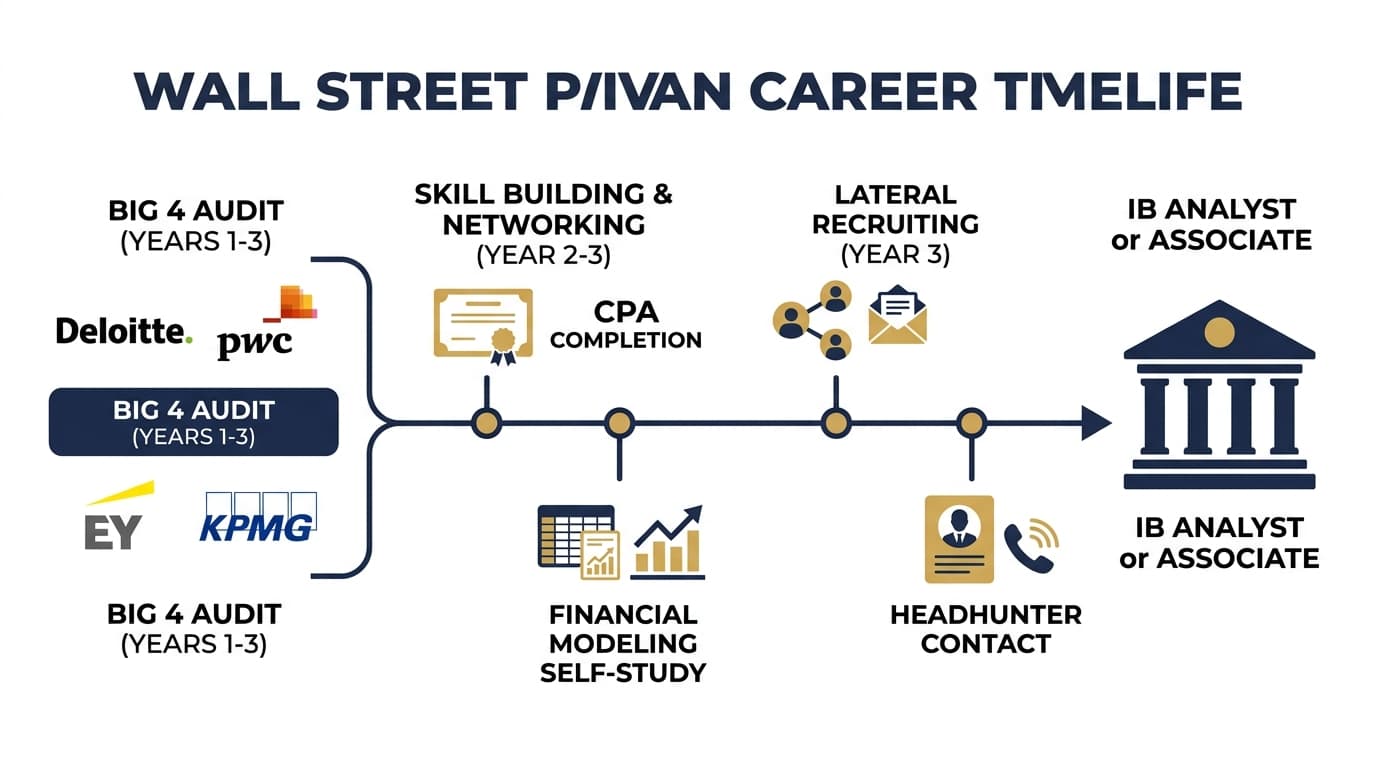
Here's what most guides won't tell you: this transition typically takes 6–18 months of dedicated preparation alongside your full-time audit job. That means studying on nights and weekends during busy season—when you're already working 60–80 hours.
Optimal timing:
- 1–2 years into audit is the sweet spot. You have enough professional credibility to be taken seriously, and you're young enough that banks will slot you in as a first-year analyst.
- 3–4 years into audit still works, but you'll likely need to target analyst roles at middle-market or boutique banks, or occasionally associate-level roles at banks that value the accounting background.
- 5+ years in audit makes the direct transition significantly harder. At this point, most successful switchers go through an intermediary step—valuation advisory, transaction advisory (TAS/FAAS), or an MBA.
The TAS stepping stone: If you're at a Big 4 firm, transferring internally to the Transaction Advisory Services group is the single highest-probability path to investment banking. TAS teams work on due diligence for M&A transactions, giving you direct deal experience and a much more compelling story for banking interviews. Many banks specifically recruit from Big 4 TAS groups.
What You Need to Learn
Audit trains you to verify numbers. Investment banking requires you to project them. The skill gap is real, but it's bridgeable.
Technical Knowledge
Financial modeling. You need to be able to build a DCF from scratch, construct an LBO model, and perform comparable company analysis. Audit gives you strong accounting fundamentals, but you've never built a forward-looking three-statement model. This is your biggest gap.
Valuation methodologies. DCF, trading comps, precedent transactions, LBO analysis, sum-of-the-parts. You need to understand not just the mechanics but the judgment calls—when to use each method, what drives value, how to sanity-check outputs.
Accounting for banking. Your GAAP knowledge is an asset, but you need to learn how bankers think about accounting: quality of earnings adjustments, normalized EBITDA, working capital analysis, pro forma financials. The framing is different from audit.
Get the 10 resume bullets PDF
Use the free before-and-after bullet examples before you apply or start networking.
No spam. Unsubscribe anytime.
Knowledge You Already Have (and How to Leverage It)
Your Big 4 background gives you several genuine advantages:
- Financial statement fluency. You can read a 10-K faster and more critically than most junior bankers. This is a real edge.
- Attention to detail. Audit instills a discipline around accuracy that banks value.
- Work ethic. You've survived busy season. Banks know you can handle long hours.
- Professional communication. You've worked with CFOs, controllers, and audit committees. Many banking analysts have never had a real client interaction.
The key is reframing these skills in banking terms during interviews. Don't talk about testing controls or sampling—talk about your ability to analyze financial statements, identify accounting risks, and work under pressure with senior executives.
The Networking Strategy
Networking is where the Big 4 to banking transition is won or lost. Banks don't post most lateral openings on job boards. The majority of successful transitions happen through direct outreach and referrals.
Who to Target
Big 4 alumni who made the switch. These people exist at virtually every bank. They understand your background, they've been where you are, and they're often willing to help. Use LinkedIn to find them. Your firm's alumni network is a goldmine.
Bankers who cover industries you've audited. If you audited healthcare companies, reach out to healthcare banking groups. Your industry knowledge is a genuine differentiator.
Recruiters who specialize in lateral placements. Headhunters like Oxbridge Group, Dynamics Search Partners, and SG Partners place laterals into banking roles. Having a recruiter in your corner can open doors.
How to Network Effectively
- Be specific about what you want. "I'm interested in investment banking" is too vague. "I'm targeting analyst roles in healthcare or industrials coverage at middle-market banks" shows you've done your homework.
- Lead with value, not asks. Share an industry insight from your audit work. Ask thoughtful questions about their deal experience. Don't open with "can you refer me?"
- Follow up consistently. One coffee chat doesn't create a relationship. Follow up every 4–6 weeks with a brief note, a relevant article, or an update on your preparation.
- Cast a wide net. Target 50–100 outreach contacts. Expect a 15–25% response rate. You need 10–20 real conversations to generate 2–3 solid referrals.
Common Mistakes That Kill the Transition
1. Waiting Too Long
Every additional year in audit past the 2-year mark makes the transition harder. Banks prefer to train junior talent. If you know you want to switch, start preparing immediately.
2. Skipping the Technical Preparation
You will be asked to walk through a DCF, explain an LBO, and discuss enterprise value vs. equity value. Big 4 auditors who assume their accounting knowledge is sufficient get destroyed in technicals. Invest 100–200 hours in dedicated technical preparation.
Recommended Resource
How to Break Into Finance - 2026
110 pages. The recruiting system from first target list to signed offer.
3. Telling the Wrong Story
"I hate audit and want to make more money" is honest but fatal. Your story needs to focus on genuine interest in advising companies on strategic decisions, working on transactions, and building a career in capital markets. It needs to be authentic—interviewers can smell a rehearsed script.
4. Only Targeting Bulge Brackets
Goldman Sachs and Morgan Stanley are not going to hire you out of Big 4 audit. Boutique and middle-market banks (Houlihan Lokey, William Blair, Baird, Harris Williams, Raymond James) are far more receptive to Big 4 laterals. A year at a strong middle-market bank is a perfectly viable stepping stone to a larger platform later.
5. Neglecting the Lifestyle Reality
Investment banking hours are worse than busy season—except busy season never ends. Auditors who switch for the money without genuinely wanting the work tend to burn out within 18 months. Make sure you're switching toward something, not just away from audit.
The Interview Process
Banking interviews for Big 4 laterals typically include:
Behavioral questions: Your story, why banking, why this bank, leadership examples. The "why banking" question is where Big 4 candidates succeed or fail. You need a crisp, 60-second narrative that connects your audit experience to genuine interest in advisory work.
Technical questions: DCF mechanics, valuation concepts, accounting questions (where you should shine), enterprise value, merger models, LBO basics. Expect the accounting questions to be harder for you because interviewers assume it's your strength.
Deal discussion: Be prepared to walk through a recent transaction in your target industry. Pick an M&A deal, understand the strategic rationale, the valuation, and the key financial dynamics.
Case studies / modeling tests: Some banks will give you a take-home modeling test. This is where your preparation pays off—or doesn't. Practice building models under time pressure.
Positioning Your Background
Your resume is the first thing that needs to change. A resume written for Big 4 career progression won't work for banking applications. You need to reframe your experience around financial analysis, client advisory, and transaction relevance.
For a resume format specifically designed for Big 4 professionals transitioning to finance roles, see our public accounting to finance resume template. It's built to translate audit and advisory experience into language that banking hiring managers respond to.
The Bottom Line
The Big 4 to investment banking transition is achievable, but it requires 6–18 months of focused preparation, aggressive networking, and honest self-assessment. The auditors who make it are the ones who treat the transition like a project—with milestones, deadlines, and accountability.
Start with the technical preparation. Build the network in parallel. Target the right banks. Tell an authentic story. And move quickly—every busy season you complete without making the switch is another year of compounding opportunity cost.