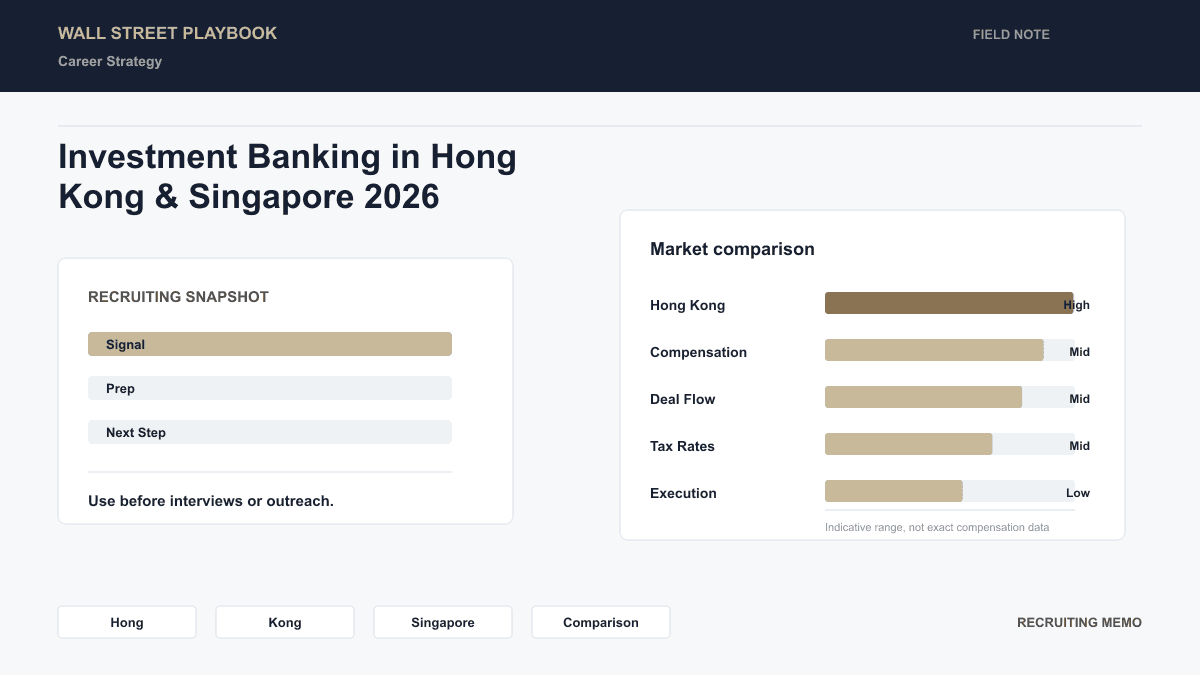
Hong Kong and Singapore are the two dominant investment banking hubs in Asia-Pacific. Together, they house the regional headquarters of every bulge bracket bank, most elite boutiques, and a growing ecosystem of local and regional firms.
But banking in Asia is not a copy-paste of New York. The deals are different, the recruiting process has its own rules, the culture is distinct, and one language skill has become quietly non-negotiable. If you're targeting Asia IB, whether you're based in the region or considering a move from the US or Europe, this guide covers everything you need to know.
Preparing for technicals? The core interview questions are the same globally. Our Finance Technical Interview Guide covers every question tagged by frequency with 30-second and 3-minute answer formats. Master the fundamentals before your first interview.
Hong Kong vs. Singapore: Which Hub Is Right for You?
Hong Kong
The deal flow: Hong Kong is the gateway to Greater China. The majority of deal activity involves mainland Chinese companies, IPOs, cross-border M&A, and capital markets transactions. If you want exposure to the world's second-largest economy, Hong Kong is where the action is.
The reality in 2026:
- Deal activity is recovering after a challenging 2022-2024 period driven by regulatory crackdowns and geopolitical tensions
- Chinese IPO activity, once Hong Kong's crown jewel, has shifted, many companies now list on mainland exchanges (Shanghai, Shenzhen)
- Cross-border M&A remains active, particularly outbound Chinese acquisitions in Southeast Asia and the Middle East
- Banks are cautiously rebuilding headcount after significant layoffs in 2023-2024
Language: Mandarin is now effectively essential for Hong Kong IB roles, even though it's rarely listed as a formal requirement. Cantonese is valuable for local client relationships but Mandarin is the deal language. If you don't speak Mandarin, your career ceiling in Hong Kong IB will be significantly lower than peers who do.
Lifestyle: Hong Kong is expensive, among the most costly cities in the world for housing. Expect to share a small apartment for the first few years. The work-life balance is similar to New York: long hours, demanding clients, and the expectation of being always available.
Singapore
The deal flow: Singapore has emerged as the alternative to Hong Kong for banks hedging their China exposure. Deal activity centers on Southeast Asia (Indonesia, Vietnam, Thailand, Philippines), India-linked transactions, and increasingly, Middle East capital flows.
The reality in 2026:
- Singapore is the fastest-growing IB hub in Asia-Pacific
- Multiple banks have shifted senior coverage bankers from Hong Kong to Singapore
- Southeast Asian M&A is booming, driven by infrastructure spending, tech consolidation, and family-office-driven transactions
- The Monetary Authority of Singapore (MAS) has created a favorable regulatory environment that attracts global capital
Language: English is the primary business language. Mandarin is a significant advantage (many clients are ethnic Chinese business owners across Southeast Asia) but not as critical as in Hong Kong. Bahasa Malay/Indonesian is a differentiator for Indonesia-focused coverage.
Lifestyle: Singapore is expensive but more livable than Hong Kong, better housing quality, lower taxes, excellent public infrastructure. The hours are generally similar to Hong Kong, though some bankers report slightly better work-life balance compared to the Hong Kong grind.
The Bottom Line
| Factor | Hong Kong | Singapore |
|---|---|---|
| Deal focus | Greater China, mainland IPOs | Southeast Asia, India, Middle East |
| Language | Mandarin essential | English primary, Mandarin a plus |
| Growth trajectory | Stabilizing after decline | Rapidly growing |
| Cost of living | Very high | High |
| Visa/work permit | Straightforward for finance | Competitive but achievable |
| Exit opportunities | PE/HF (China-focused) | PE/VC (SEA-focused), family offices |
Compensation: Asia vs. New York
Let's address the elephant in the room. Asia IB pays less than New York, but the gap is narrower than you might think.
2026 Analyst Compensation
| Level | New York (USD) | Hong Kong (USD equiv.) | Singapore (USD equiv.) |
|---|---|---|---|
| Analyst 1 Base | $110,000 | $85,000-90,000 | $85,000-90,000 |
| Analyst 1 Bonus | $80,000-100,000 | $47,000-58,000 | $47,000-58,000 |
| Analyst 1 Total | $190,000-210,000 | $132,000-148,000 | $132,000-148,000 |
| Analyst 2 Base | $120,000 | $95,000-100,000 | $95,000-100,000 |
| Analyst 2 Bonus | $100,000-130,000 | $57,000-65,000 | $57,000-65,000 |
| Analyst 3 Base | $130,000 | $105,000-110,000 | $105,000-110,000 |
Key nuances:
- Hong Kong and Singapore pay roughly 20-30% less than New York at the analyst level
- Bonuses in Asia average 55-65% of base, compared to 70-100% in New York
- Singapore has significantly lower taxes than both Hong Kong and New York, partially closing the after-tax gap
- Hong Kong has no capital gains tax and a flat income tax rate (~15%), making the effective take-home competitive
- Deferred compensation is rare in Asia, only 5-10% of analysts receive deferred bonuses
The tax advantage matters. A Singapore analyst earning $140,000 total may take home more after tax than a New York analyst earning $180,000, depending on filing status and deductions.
Get finance recruiting and compensation updates
Weekly notes on salary data, recruiting windows, technical prep, and role-specific next steps.
No spam. Unsubscribe anytime.
Recruiting Timeline: How Asia Differs
For Undergrads at Asian Universities
The Asia recruiting timeline overlaps with but differs from the US cycle:
September-October 2025: Major banks open applications for summer 2026 analyst programs in Hong Kong and Singapore. Goldman Sachs, JPMorgan, Morgan Stanley, and HSBC all recruit on this timeline.
November-January: First-round interviews (HireVue, phone screens, online assessments)
February-April 2026: Assessment centers, Superdays, and offers. Some banks run in-person assessment centers where candidates complete group exercises, case studies, and individual interviews over 1-2 days.
Key differences from US recruiting:
- Assessment centers (group exercises + case studies) are more common in Asia than in the US, where Superdays are purely interview-based
- Language tests may be included (written Mandarin or verbal assessments)
- Some banks run separate tracks for different divisions (IBD, Markets, Research)
- The process is generally less networked than the US, cold applications have a higher success rate at Asian offices
For US-Based Candidates Targeting Asia
If you're at a US university and want to recruit for Asia offices:
- Apply through the bank's Asia-Pacific portal, not the US portal
- Highlight language skills prominently on your resume
- Network with bankers in the specific Asian office, New York contacts can't help you with Hong Kong recruiting
- Be prepared to explain your connection to the region (family, study abroad, cultural ties, deal interest)
- Some banks allow you to preference a region during the application process; others require separate applications
The Deal Landscape in Asia
Understanding what you'll actually work on is critical for interviews and for deciding if Asia IB is right for you.
Hong Kong: China-Centric Deals
Typical transactions:
- Chinese company IPOs on HKEX (though volume has declined)
- Cross-border M&A: Chinese companies acquiring assets in Southeast Asia, Europe, or Africa
- Restructuring and liability management for Chinese property developers
- H-share and Red Chip offerings
- Convertible bond issuances for Chinese tech companies
Sectors that dominate: Technology, healthcare/biotech, real estate, industrials, new energy/EV
Singapore: Southeast Asia and Beyond
Typical transactions:
- M&A in Indonesia, Vietnam, and Thailand (infrastructure, consumer, fintech)
- Capital markets transactions for Southeast Asian corporates
- Family-office-driven M&A (prominent in Singapore's ecosystem)
- India-linked transactions (many Indian companies use Singapore as a listing/holding hub)
- Middle East sovereign wealth fund investments
Sectors that dominate: Technology/fintech, infrastructure, consumer/retail, real estate, energy transition
Taiwan: A Growing Niche
Taiwan has a smaller but active IB market, primarily driven by:
- Semiconductor and technology M&A (TSMC ecosystem)
- Cross-strait transactions
- Local IPOs on TWSE/TPEx
- Private equity activity in tech manufacturing
Major banks with Taipei operations include Goldman Sachs, JPMorgan, Citi, and Nomura. Mandarin fluency is essential. A Taiwan Brokerage License is preferred for some roles.
Recommended Resource
Finance Technical Interview Guide
80+ pages. Every question tagged by frequency with answer formats, red flags, and practice structure.
Interview Differences in Asia
The core technical questions are the same globally, you still need to know how to walk through a DCF, explain how the three financial statements link, and understand enterprise value vs. equity value.
But Asia interviews add some wrinkles:
1. Market knowledge is regionally specific. Don't discuss US deals if you're interviewing for Hong Kong IBD. Know the top 3-5 recent transactions in the Asia-Pacific region. Follow the South China Morning Post, Nikkei Asia, or The Business Times.
2. Assessment centers test collaboration, not just individual brilliance. Group exercises, where you're given a case study to solve as a team while being observed, are common at Asia offices. Banks are evaluating how you contribute to group dynamics, not just whether you get the right answer.
3. Language may be tested. Some banks will switch to Mandarin mid-interview to test fluency. Others include a written Mandarin component. If you've listed Mandarin on your resume, be prepared to prove it.
4. "Why Asia?" is the equivalent of "Why banking?" If you're from the US or Europe, expect intense scrutiny on why you want to work in Asia. Generic answers ("Asia is the future of growth") won't cut it. Tie it to specific deals, personal connections, or long-term career goals rooted in the region.
5. Cultural fit is assessed differently. Asian offices tend to value humility, team orientation, and respect for hierarchy more explicitly than US offices. This doesn't mean you should be passive, but calibrate your tone. Confidence without arrogance plays especially well.
Exit Opportunities from Asia IB
Hong Kong Exits
- Private equity (China-focused): Baring Private Equity, CITIC Capital, Hillhouse Capital, CDH Investments, PAG
- Hedge funds: Asia-focused hedge funds in Hong Kong (Point72 Asia, Citadel Asia, Millennium Asia)
- Corporate development: Chinese tech companies (Tencent, Alibaba, ByteDance)
- Sovereign wealth funds: GIC, Temasek (Singapore-based but hire from Hong Kong)
Singapore Exits
- Private equity (SEA-focused): Warburg Pincus (Singapore office), KKR Asia, Bain Capital Asia
- Venture capital: Sequoia Capital Southeast Asia, GGV Capital, Vertex Ventures
- Family offices: Singapore's booming family office ecosystem (1,000+ single-family offices)
- Sovereign wealth funds: GIC, Temasek, among the most prestigious exits in Asia
- Corporate development: Grab, Sea Group, GoTo, Shopee
Taiwan Exits
- Private equity: KKR, Bain Capital, and local PE firms
- Corporate strategy: Semiconductor and tech manufacturing companies
- Venture capital: Growing tech VC ecosystem in Taipei
Key Takeaways
- Singapore is the momentum play in Asia IB, growing headcount, diversified deal flow, favorable regulatory environment
- Hong Kong remains the China gateway but carries more geopolitical and regulatory risk than pre-2020
- Mandarin is non-negotiable for Hong Kong and a strong differentiator for Singapore
- Compensation is 20-30% below New York in absolute terms, but favorable tax regimes narrow the gap significantly
- Assessment centers are more common in Asia, prepare for group exercises and collaborative case studies
- Technical fundamentals are universal, the core questions are the same whether you're in New York, London, Hong Kong, or Singapore
- Exit opportunities are strong in both hubs, with Singapore offering unique access to VC, family offices, and sovereign wealth funds
Related Reading
- Target Schools for Investment Banking in Asia 2026, Which universities place into IB in Hong Kong and Singapore
- Breaking Into Wall Street as an Asian Candidate, Leveraging your background as an advantage
- Bulge Bracket Investment Banking Salary 2026, US compensation for comparison
- Non-Target to Investment Banking: 2026 Playbook, The recruiting strategy that works in any market
Your technical prep doesn't change by geography. Our Finance Technical Interview Guide covers every question you'll face in Asia or the US, 88 pages with frequency tags, dual-format answers, and red flag warnings. Get it before your assessment center.