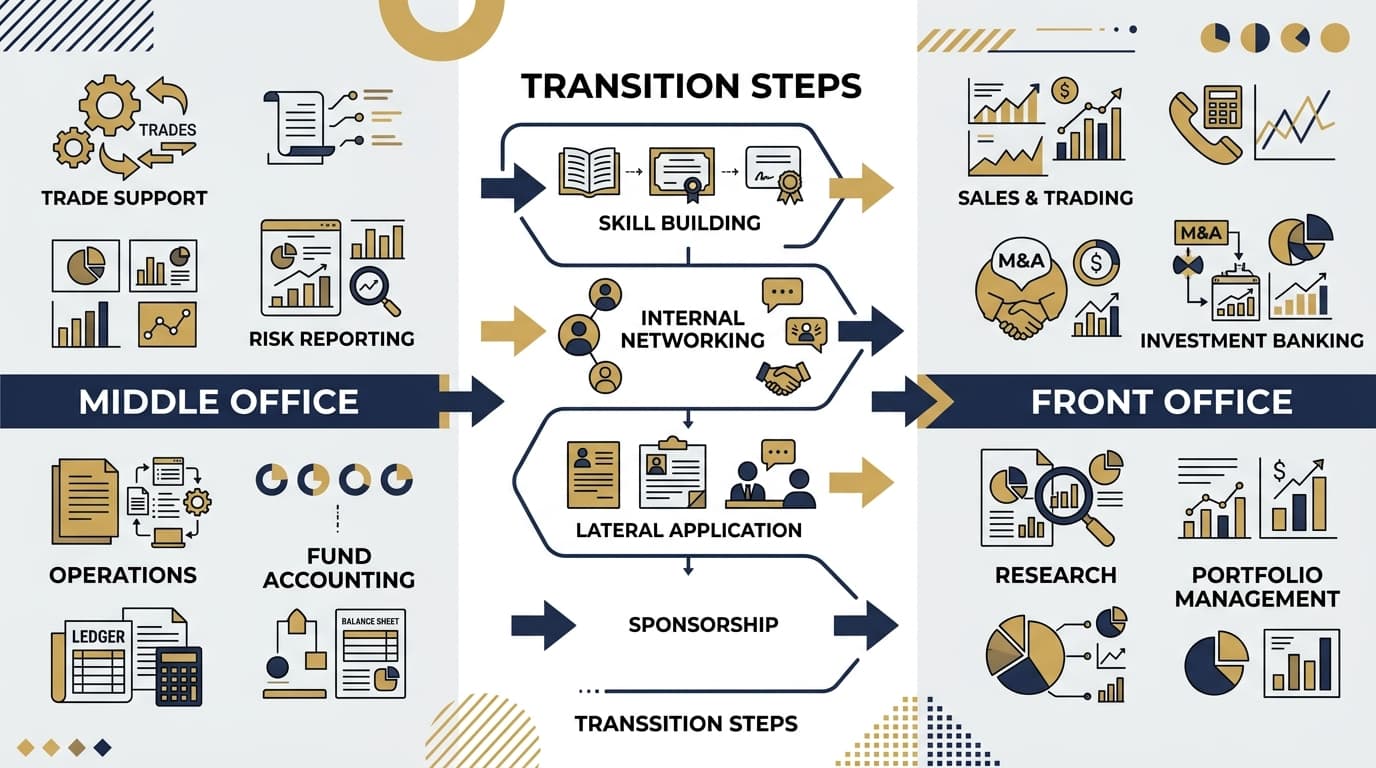
If you work in middle office—trade support, operations, risk reporting, fund accounting, or portfolio analytics—you've probably felt the pull of the front office. The revenue-generating side of finance carries higher compensation, more prestige, and broader exit opportunities. And you're close enough to see it every day, which makes the gap feel both small and enormous at the same time.
The middle-office-to-front-office transition is real. It happens. But it happens far less frequently than online forums suggest, and the professionals who pull it off approach it with clear-eyed strategy rather than wishful thinking.
This guide provides an honest assessment of what the transition requires, where the realistic opportunities are, and how to maximize your odds.
Understanding the Gap
Before planning the transition, you need to understand exactly what separates middle office from front office—because it's not just a job title.
Front office roles (sales, trading, investment banking, research, portfolio management) generate revenue directly. Compensation is tied to deal flow, trading P&L, or assets under management. The work involves making decisions under uncertainty with real money on the line.
Middle office roles (trade support, risk management, compliance, fund accounting, performance reporting) support the revenue-generating functions. The work is essential—front office can't function without it—but it's evaluated on accuracy and process efficiency rather than revenue generation.
The core gap isn't technical—it's commercial. MO professionals often have strong analytical skills, deep product knowledge, and excellent attention to detail. What they typically lack is revenue orientation, client interaction experience, and the risk-taking mindset that defines front office culture.
Realistic Assessment: How Hard Is This?
Let's be honest about the difficulty level by destination:
| Target Role | Difficulty | Typical Path |
|---|---|---|
| Sales / Relationship Management | Moderate | Internal transfer, often into sales support first |
| Equity Research | Moderate–Hard | Strong sector knowledge + CFA + writing samples |
| Risk Management (FO-aligned) | Moderate | Lateral into market risk or portfolio risk |
| Trading | Very Hard | Rare without a total restart (MBA or prop trading) |
| Investment Banking | Very Hard | MBA almost always required |
| Portfolio Management | Extremely Hard | Multi-year transition through research track |
The most achievable transitions are into sales roles, front-office risk management, and equity research. Trading and investment banking are much harder to access from middle office, and realistic self-assessment here saves years of misdirected effort.
Where Middle Office Experience Is an Advantage
Your MO background isn't just a liability to overcome—it provides genuine advantages in certain front-office contexts:
Product expertise. If you've spent 3 years supporting structured credit operations, you understand the mechanics of CLOs, CDOs, and ABS better than most junior traders. That knowledge has value in sales, structuring, and risk roles.
Operational understanding. Front-office professionals who understand settlement, margin, clearing, and operational risk are more effective than those who don't. This is particularly valued in sales, where operational hiccups lose client relationships.
Regulatory and compliance awareness. In a post-2008 regulatory environment, understanding Dodd-Frank, Basel III, and reporting requirements is increasingly valuable in front-office decision-making.
Systems knowledge. Understanding trading platforms, order management systems, and data infrastructure is valuable in quant-adjacent roles, electronic trading, and fintech.
Get weekly finance recruiting intel
Technical prep tips, recruiting timeline updates, and career strategies. No spam.
No spam. Unsubscribe anytime.
The Transition Strategy
Step 1: Pick a Specific Target
"I want to move to front office" isn't a strategy. You need to identify a specific role, at a specific type of firm, that aligns with your existing skills. The closer the target is to your current skill set, the higher your probability of success.
High-probability targets based on current role:
- Trade support → Sales / Sales trading
- Risk reporting → Market risk / Portfolio risk (FO-aligned)
- Fund accounting / Performance → Client portfolio management / Research
- Operations management → COO of a trading desk or FO ops leadership
- Valuation / Pricing → Structuring / Quant support
Step 2: Build the Missing Skills
Once you've identified the target, audit the skill gap honestly:
For sales roles: You need client interaction experience, market commentary ability, and product pitch skills. Start by attending client calls if possible, writing market summaries for internal distribution, and studying how the sales team communicates.
For research roles: You need analytical writing, financial modeling, and sector expertise. Start writing investment memos on companies in your sector. Build models. Pursue the CFA if you haven't already.
For risk roles (FO-aligned): Deepen your quantitative skills. Learn Python or R for risk analytics. Understand VaR, stress testing, and scenario analysis at a sophisticated level. The FRM designation carries weight here.
Step 3: Network Internally First
The highest-probability path from MO to FO is an internal transfer at your current firm. Here's why:
- Hiring managers already know your work ethic and reliability
- Internal transfers are lower-risk for the hiring manager than external hires
- You understand the firm's systems, culture, and clients
- Many firms have formal mobility programs that facilitate these moves
How to network internally:
- Build relationships with the front-office teams you support directly
- Volunteer for cross-functional projects that give you FO visibility
- Ask your manager to support an informational conversation with FO leaders
- Express your interest clearly—don't hint, state it explicitly
The professionals who successfully transfer internally are the ones who make their ambitions known early and consistently. If your current manager is unsupportive, go around them—carefully—through mentorship programs, HR-facilitated mobility, or direct outreach to FO managers.
Step 4: Develop Your External Profile
If internal transfer isn't feasible, you need to build an external case:
CFA charter. For research and portfolio management transitions, the CFA signals seriousness and provides a knowledge framework that bridges the MO/FO gap.
Writing and publishing. Start a Substack, write on LinkedIn, or contribute to industry publications. Original analysis in your sector demonstrates the thinking skills that front-office roles require.
Certifications and technical skills. FRM for risk, Series 7/63 for sales, Python/SQL for quant-adjacent roles. These don't guarantee a transition, but they remove objections.
Recommended Resource
How to Break Into Finance - 2026
110 pages. The recruiting system from first target list to signed offer.
Step 5: Position Your Resume
This is where most MO professionals fail. A resume that describes operational processes and support functions doesn't translate to front-office hiring managers. You need to reframe your experience around:
- Revenue impact: How did your work enable or protect revenue?
- Risk decisions: What judgment calls did you make that affected outcomes?
- Client interaction: Any client-facing experience, even secondary
- Analytical output: Reports, models, or analyses that influenced decisions
For a resume format designed for this exact transition, see our finance operations resume template. It's structured to reframe middle-office experience in terms that front-office hiring managers understand and value.
The MBA Question
If you're 3+ years into a middle-office career and targeting investment banking, trading, or buy-side roles at top-tier firms, an MBA from a target school (M7 or top-15) is likely your most reliable path. It's expensive and time-consuming, but it effectively resets your career trajectory and gives you access to OCR pipelines that are otherwise closed.
An MBA is overkill if you're targeting sales, FO risk, or research at your current firm via internal transfer. Don't use a $200K degree to accomplish something that networking and skill-building could achieve in 12 months.
Timeline Expectations
| Transition Type | Realistic Timeline |
|---|---|
| Internal transfer (MO → FO at same firm) | 6–18 months |
| External move to similar-level FO role | 12–24 months |
| MBA-facilitated transition | 2–3 years (including MBA) |
| Cold application with no network or credentials | Very unlikely |
The Honest Truth
Not every middle-office professional will make it to front office, and that's fine. Middle office roles—particularly in risk management, operations leadership, and technology—have their own compelling career trajectories with strong compensation and genuine intellectual challenge. The COO of a trading desk, the head of market risk, or a senior operations executive at an asset manager earns well into six figures with significantly better hours than most front-office roles.
Pursue the transition if you genuinely want the work, not just the title. And if you decide to stay in middle office, invest in becoming excellent at it—the best MO leaders are highly valued and increasingly well compensated.