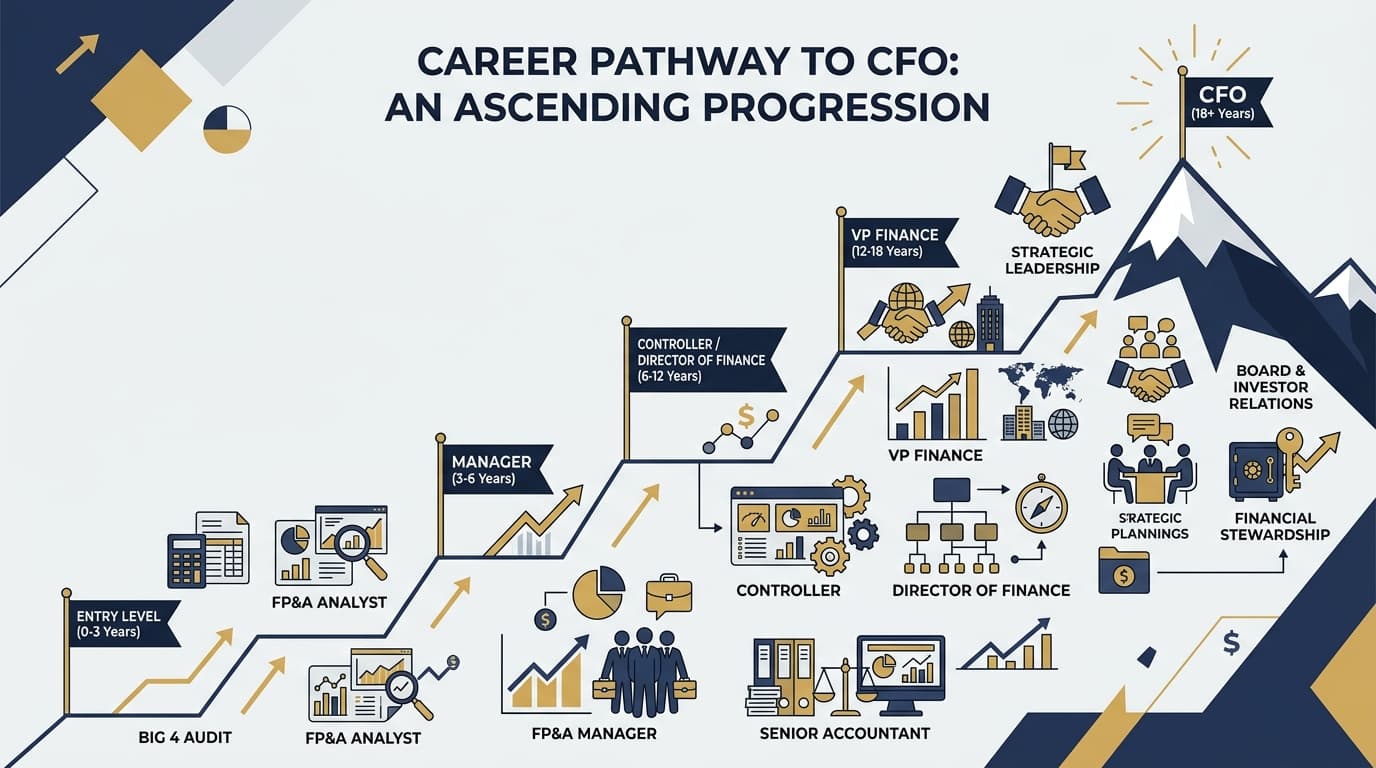
The Chief Financial Officer role sits at the intersection of strategy and execution. A CFO doesn't just report numbers—they shape capital allocation, drive M&A decisions, manage investor relationships, and serve as the CEO's closest strategic partner. It's one of the most powerful seats in any organization, and the competition for it is intense.
But the path to CFO is more predictable than most people realize. While no two trajectories are identical, the vast majority of sitting CFOs followed one of a handful of well-worn routes. Understanding these paths—and their tradeoffs—gives you a significant advantage in planning your career.
The Classic CFO Career Trajectory
| Stage | Title | Typical Years | Compensation Range |
|---|---|---|---|
| 1 | Big 4 Auditor / Staff Accountant | 0–4 years | $60K–$95K |
| 2 | Senior Accountant / FP&A Analyst | 4–7 years | $90K–$140K |
| 3 | FP&A Manager / Accounting Manager | 7–10 years | $130K–$180K |
| 4 | Controller / Director of Finance | 10–15 years | $170K–$260K |
| 5 | VP of Finance | 15–20 years | $240K–$400K |
| 6 | CFO | 20–25+ years | $350K–$1M+ (public company) |
At startups and smaller companies, the timeline compresses dramatically. It's not uncommon for someone to hold a CFO title at a Series B startup by their early 30s—though the scope, compensation, and complexity differ enormously from a Fortune 500 CFO.
Phase 1: Building the Technical Foundation (Years 0–7)
The Big 4 Starting Point
Roughly 40–50% of Fortune 500 CFOs spent time at a Big 4 firm (Deloitte, PwC, EY, KPMG). There's a reason: public accounting builds a technical fluency in financial reporting, internal controls, and audit methodology that's difficult to replicate elsewhere.
The ideal Big 4 stint is 3–4 years—long enough to earn your CPA and make senior associate or manager, short enough that you don't get pigeonholed as a career auditor. Staying past manager without a clear path to partner means you're trading years of corporate finance experience for diminishing returns.
What you're building:
- CPA licensure (non-negotiable for most CFO tracks)
- Deep understanding of GAAP, SEC reporting, and internal controls
- Exposure to multiple industries and business models
- A professional network that will pay dividends for decades
The FP&A Entry Point
Some future CFOs skip Big 4 entirely and enter corporate finance through FP&A analyst roles. This path builds budgeting, forecasting, and business partnering skills earlier, but you'll need to fill the accounting and controls gap later—often by managing an accounting team or earning a CPA independently.
FP&A analysts who aspire to CFO should prioritize roles with direct exposure to senior leadership. The analyst building the board deck and briefing the VP of Finance on variance analysis is learning faster than the one buried in consolidation spreadsheets.
Phase 2: The Controller Track (Years 7–15)
The controller role is the single most common stepping stone to CFO. A controller owns the integrity of the financial statements, manages the close process, oversees accounting operations, and often handles tax, treasury, and compliance.
Why it matters for CFO readiness:
- You learn to own the numbers—not just analyze them
- You build credibility with auditors, the board, and regulators
- You develop operational leadership skills managing a team of 5–50+
- You gain intimate knowledge of the systems, processes, and controls that underpin financial reporting
The controller-to-CFO pipeline is strongest at mid-market companies ($100M–$2B revenue) where the controller already functions as a de facto CFO. At larger enterprises, the gap between controller and CFO is wider, and you'll typically need a VP Finance stint in between.
The CPA question: If you didn't start in Big 4, the controller phase is where the lack of a CPA becomes a real liability. Most CFO search firms and boards expect it. Get it done.
Get weekly finance recruiting intel
Technical prep tips, recruiting timeline updates, and career strategies. No spam.
No spam. Unsubscribe anytime.
Phase 3: VP of Finance (Years 15–20)
The VP of Finance role is where you transition from financial stewardship to strategic leadership. At this level, you're not just reporting what happened—you're shaping what happens next.
Key responsibilities that differentiate VP Finance from Controller:
- Capital allocation recommendations and scenario modeling
- M&A due diligence, integration planning, and post-merger analysis
- Investor relations support (for public companies) or fundraising support (for private companies)
- Cross-functional strategic initiatives (pricing, market entry, restructuring)
- Building and leading a finance organization across multiple functions
This is the phase where many capable finance professionals plateau. The jump from VP Finance to CFO requires a fundamentally different skill set—less technical precision, more strategic judgment, executive presence, and board-level communication.
What boards and CEOs look for in a CFO that VP Finance doesn't always develop:
- Comfort with ambiguity and incomplete information
- The ability to translate financial data into strategic narrative
- Experience managing external stakeholders (investors, lenders, analysts)
- A track record of influencing business decisions beyond finance
Alternative Paths to CFO
The Investment Banking Route
A meaningful minority of CFOs—particularly at companies that are M&A-intensive or recently public—come from investment banking backgrounds. Bankers bring transaction expertise, capital markets fluency, and a polished approach to investor communication. The gap they must fill is operational finance: close processes, internal controls, FP&A cycles, and team management.
Former bankers who become CFOs typically transition through a corporate development or strategy role first, then move laterally into a VP Finance or divisional CFO position.
The Consulting Route
Strategy consultants from McKinsey, BCG, or Bain occasionally land CFO roles, usually at companies that value strategic transformation over accounting rigor. These transitions almost always require an intermediate operating role (Head of Strategy, COO, divisional GM) before the CFO appointment.
The Divisional CFO Route
At large enterprises, the most common internal path to Group CFO runs through divisional or business unit CFO roles. These positions offer P&L ownership, operational decision-making, and board exposure on a smaller scale—essentially a CFO apprenticeship.
Skills That Separate CFOs from VP Finance
Technical accounting and financial analysis are table stakes by the time you reach VP Finance. The differentiators at the CFO level are almost entirely about leadership and judgment:
Strategic communication. CFOs present to boards, investors, and analysts. You need to distill complex financial realities into clear, compelling narratives. Practice this skill deliberately—volunteer for board presentations, lead earnings call prep, write the shareholder letter.
Capital allocation. The CEO proposes; the CFO pressure-tests. Understanding when to invest, divest, return capital, or hold cash is the core intellectual challenge of the role. Study capital allocation frameworks. Read Buffett's shareholder letters. Build your own framework through experience.
Risk management. Not just financial risk, but strategic risk. The best CFOs are the ones who flag the risks nobody else is talking about—and propose solutions rather than just raising alarms.
Talent development. A CFO builds the finance organization. Your ability to recruit, develop, and retain exceptional finance talent is a direct determinant of your effectiveness.
Recommended Resource
How to Break Into Finance - 2026
110 pages. The recruiting system from first target list to signed offer.
Compensation at the CFO Level
CFO compensation varies dramatically by company size and stage:
| Company Type | Base Salary | Total Comp (incl. equity) |
|---|---|---|
| Startup (Series A–C) | $200K–$300K | $400K–$1.5M (heavy equity) |
| Mid-market private | $250K–$400K | $400K–$800K |
| Public (small/mid-cap) | $350K–$500K | $800K–$2M |
| Public (large-cap) | $500K–$800K | $2M–$10M+ |
Equity compensation—stock options, RSUs, performance shares—makes up the majority of total comp at public companies and high-growth startups. The potential upside from equity is what makes the CFO role exceptionally lucrative at the right company.
The Timeline: How Long Does It Really Take?
For the traditional path (Big 4 → Corporate Finance → Controller → VP Finance → CFO), expect 18–25 years. The median age of a Fortune 500 CFO is approximately 50.
Accelerated paths exist. Joining a high-growth startup or private equity-backed company can compress the timeline to 12–15 years, though you're trading brand-name experience for speed and scope. Some professionals oscillate—building credentials at large companies, then taking a CFO seat at a smaller one, then leveraging that title to move to a larger firm.
The most important variable isn't time—it's breadth. CFOs who advance fastest are those who deliberately build experience across accounting, FP&A, treasury, investor relations, and strategic planning rather than going deep in a single function.
Positioning Your Resume for the CFO Track
If you're actively pursuing the CFO path, your resume needs to tell a story of increasing scope, strategic impact, and cross-functional leadership. Quantify everything: revenue growth you supported, cost savings you identified, transactions you executed, teams you built.
For a resume specifically tailored to the CFO career trajectory, check out our CFO resume template designed to highlight the strategic finance experience that boards and executive recruiters prioritize.
Final Thoughts
The CFO path rewards patience, breadth, and strategic thinking. There's no shortcut past the technical foundation—you need to understand the numbers at a granular level before you can lead at a strategic level. But technical skill alone won't get you there. The professionals who reach CFO are the ones who consistently step beyond their functional boundaries, build relationships across the organization, and demonstrate judgment that goes beyond what the spreadsheet says.
Start planning the path now. Every role you take should either build a skill you'll need as CFO or close a gap in your experience. The title is worth the journey.