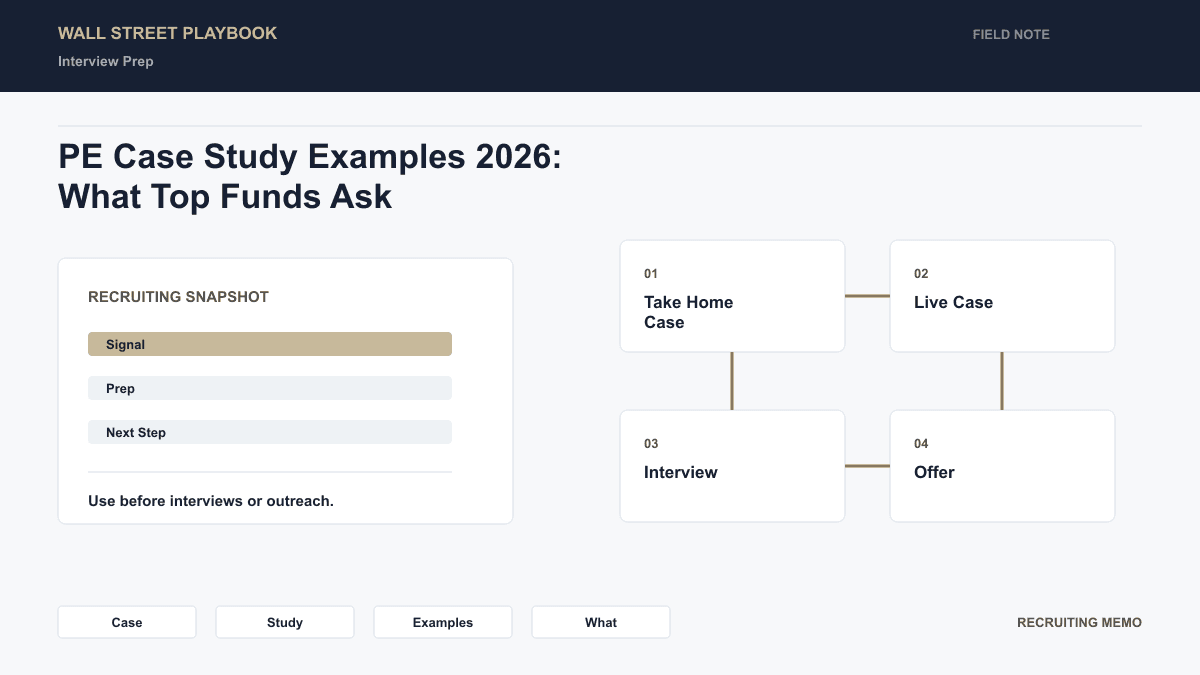
PE case studies separate candidates who can think like investors from those who just know technicals. The format varies by fund, but the core evaluation is the same: can you recommend an investment decision and defend it?
Here's what you'll actually face in 2026 on-cycle recruiting, with examples.
The Three Case Study Formats
Format 1: Take-Home LBO Model (3-5 Hours)
What you get:
- CIM excerpt or investor presentation
- 3-5 years of historical financials
- Industry context and growth assumptions
- Instructions (build an LBO, recommend go/no-go)
What they're testing:
- Can you build a functional LBO model under time pressure?
- Do you understand the key value drivers?
- Can you articulate an investment thesis (not just run numbers)?
Timeline: Usually given Friday evening, due Sunday night. Some funds give 24 hours.
Format 2: Live Case Discussion (45-60 min)
What you get:
- 10-15 page packet handed to you
- 15-20 minutes to review alone
- 30-40 minutes of Q&A with the interviewer
What they're testing:
- How you process information quickly
- Your ability to identify what matters
- Real-time investment judgment
This is the most common format for on-cycle superdays.
Format 3: Investment Memo (24-48 Hours)
What you get:
- Company research materials
- Instructions to write a 2-4 page investment recommendation
What they're testing:
- Written communication
- Ability to structure an argument
- How you'd present to an IC (investment committee)
Live Case Example #1: Consumer Products Company
This is representative of what you'd receive at a superday.
The Setup (What's in the packet)
Company: NutritionCo, a DTC vitamins and supplements brand
Financials:
- 2025 Revenue: $180M
- 2025 EBITDA: $27M (15% margin)
- Revenue Growth: 25% YoY for last 3 years
- Customer Acquisition Cost (CAC): $45
- LTV: $180
The Situation:
- Founder wants to sell
- Asking price: $350M (13x EBITDA)
- Two strategic bidders also interested
- Business is 80% subscription, 20% one-time
Questions They'll Ask
"Would you invest? At what price?"
Strong answer framework:
- State your recommendation clearly (yes/no/conditional)
- Cite 2-3 investment merits
- Acknowledge 2-3 key risks
- Explain what price makes sense and why
"I'd be interested at 10-11x, which implies $270-$300M. The business has attractive unit economics, 4x LTV/CAC, and a subscription model with predictable revenue. However, at 13x, we're paying for perfection in a category with low barriers to entry and high customer acquisition competition. I'd want to diligence customer retention rates and organic vs. paid acquisition mix before going higher."
"Walk me through the returns at $300M."
This is where your paper LBO skills matter.
- Entry: $300M at 11x = $27M EBITDA
- Debt: 4x = $108M
- Equity: $192M
- Assume 20% EBITDA growth for 2 years, then 10% for 3 years
- Exit EBITDA Year 5: ~$52M
- Exit at 10x (multiple compression): $520M
- Debt paydown: ~$120M over 5 years
- Exit equity: $520M - (~$0 debt) = $520M
- MOIC: 2.7x, IRR: ~22%
"What's the key risk?"
"Customer acquisition efficiency. If CAC rises from $45 to $60 while LTV stays flat, the business becomes unprofitable on new customer economics. I'd want to see CAC trends by channel and understand what percentage of growth comes from organic/word-of-mouth vs. paid."
"How would you create value post-acquisition?"
- Expand into retail (currently 0% of revenue, vitamins category is 60% retail)
- Launch adjacent product lines (sports nutrition, sleep supplements)
- Improve supply chain (currently outsourced, margins could expand 200-300bps with in-house manufacturing)
- Add B2B channel (corporate wellness programs)
Live Case Example #2: B2B Software
The Setup
Company: DataFlow, a B2B data integration platform
Financials:
- 2025 ARR: $40M
- 2025 EBITDA: -$2M (investing in growth)
- ARR Growth: 45% YoY
- Gross Margin: 78%
- Net Revenue Retention: 115%
- CAC Payback: 18 months
The Situation:
- Growth equity round, $100M at $500M pre-money (12.5x ARR)
- Current investors leading
- Company targeting profitability in 18 months
Get the paper LBO template
Download the free template and use it alongside your PE interview prep.
No spam. Unsubscribe anytime.
Questions They'll Ask
"Is 12.5x ARR reasonable?"
"At 45% growth with 115% NRR, this is a high-quality SaaS business. The median public SaaS comp at this growth trades at 10-15x ARR, so 12.5x is in range. However, the negative EBITDA introduces execution risk. I'd want to see the path to profitability, specifically what the margin profile looks like at scale and what happens to growth when they cut spend."
"What diligence would you prioritize?"
- Customer concentration, What % of ARR is top 10 customers?
- Cohort retention, Is NRR consistent across cohorts or inflated by older customers?
- Competitive moat, Why can't Snowflake/Databricks/incumbents replicate?
- Path to profitability, What does R&D spend look like at steady state?
"What's the exit path?"
- Strategic acquisition by larger data platform (Snowflake, Databricks, major cloud providers)
- IPO if ARR reaches $150M+ with positive cash flow
- Secondary sale to later-stage growth fund
"Given the strategic value of data integration in the modern stack, I'd expect strategic interest at scale. Snowflake acquired similar businesses at 15-20x ARR."
Take-Home LBO Example
The Prompt
You're given an investor deck for "IndustrialCo," a manufacturer of specialty valves for oil & gas and industrial applications.
Key financials:
- LTM Revenue: $320M
- LTM EBITDA: $64M (20% margin)
- Revenue growth: 5% historically (cyclical)
- Capex: $12M/year (maintenance)
- Working capital: 15% of revenue
The Ask:
- Build an LBO model
- Recommend a bid price
- Write a 1-page investment memo
How to Approach It
Step 1: Set up Sources & Uses
Assume reasonable entry multiple range (7-9x for industrial).
| Scenario | Entry Multiple | Purchase Price |
|---|---|---|
| Low | 7.0x | $448M |
| Base | 8.0x | $512M |
| High | 9.0x | $576M |
Step 2: Model the LBO
Assumptions:
- 4x senior debt, 1x junior debt = 5x total leverage
- Senior at SOFR + 400, Junior at 10% cash
- 3% revenue growth (conservative for cyclical)
- 20% EBITDA margin maintained
- Exit at 7.5x (slight multiple compression)
Step 3: Sensitivity Analysis
Your model should show IRR sensitivity to:
- Entry multiple (7x-9x)
- Exit multiple (7x-9x)
- EBITDA growth (0-5%)
Step 4: Write the Memo
Structure:
- Recommendation: Bid $480M (7.5x) with potential to stretch to $512M (8x)
- Investment Thesis: Market leader in niche, high margin, recession-tested, multiple value creation levers
- Key Risks: Cyclicality, customer concentration (top 10 = 35%), oil & gas exposure
- Value Creation: Tuck-in M&A, operational efficiency, pricing optimization
Recommended Resource
The Paper LBO Playbook
78 pages. Timed paper LBO setup, mental math shortcuts, return bridges, worked examples, and practice drills.
Investment Memo Framework
When you have 24-48 hours to write a memo, use this structure:
1. Executive Summary (Half Page)
- One-line description of the company
- Recommended action (invest/pass)
- Key investment merits (bullet points)
- Target return profile
2. Company Overview (Half Page)
- Business description
- Products/services
- End markets
- Competitive position
3. Investment Thesis (1 Page)
Three to four reasons this is a good investment:
- Market position
- Financial profile
- Value creation opportunities
- Exit path
4. Key Risks and Mitigants (Half Page)
Be honest about risks. Show you can identify them AND explain how to manage them.
5. Financial Overview (Half Page)
- Historical financials
- Projected returns (IRR/MOIC at different scenarios)
- Key sensitivities
What Separates Good from Great
Good Candidates:
- Correctly calculate returns
- Identify obvious risks
- Structure their thoughts clearly
Great Candidates:
- Have an investment point of view (not just "it depends")
- Connect the business model to the financials
- Ask clarifying questions that show they're thinking like an investor
- Discuss value creation beyond financial engineering
- Acknowledge uncertainty while still making a recommendation
The Key Question
At the end of every case, ask yourself: "Would I put my own money in this deal at this price?"
If you can't articulate why you would or wouldn't, you haven't done enough thinking.
2026 Case Study Trends
Based on recent recruiting cycles, here's what's showing up more:
- AI/Software cases, Funds want to see you can evaluate high-growth, negative EBITDA businesses
- Sustainability angles, ESG considerations in industrial cases
- Add-on M&A, "What acquisitions would you pursue?" is now a standard follow-up
- Downside scenarios, More focus on "what breaks this deal" vs. just base case returns
Prepare Like a Pro
The best preparation is reps. Do 5-10 case studies before superday season:
- Download CIMs from your bank's past deals
- Time yourself (15 min for live case review)
- Practice articulating recommendations out loud
- Get feedback from someone in PE if possible
Want the complete framework? The 2026 PE Recruiting Playbook includes 3 full case study examples with model answers, plus the exact rubric interviewers use to evaluate candidates.
Need to sharpen your LBO modeling? Start with the Paper LBO guide and then move to the PE Recruiting Playbook for complete technical prep.
Related Reading
- Paper LBO: Step-by-Step Example with Template, Master the mental math PE firms expect
- LBO Model Walkthrough: The 5-Step Framework, The full LBO with return driver analysis
- PE On-Cycle Recruiting 2026: Prep Guide & Timeline, When to prepare and what to expect
- 7 PE Headhunters That Control Megafund Access, How to get shown to the right funds