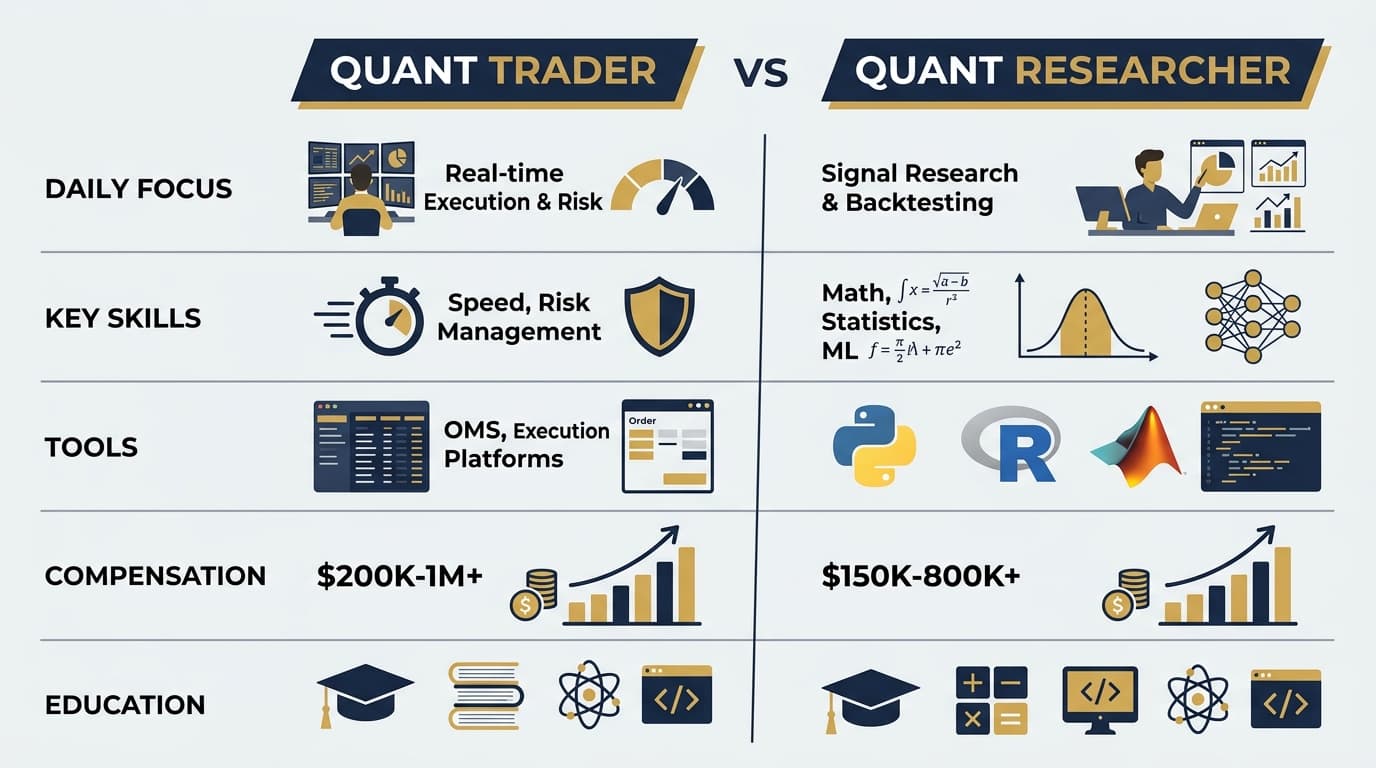
"Quant" is one of the most overused words in finance recruiting. A quant trader and a quant researcher can sit on the same floor, work on the same strategy, and have almost entirely different jobs. Understanding the distinction matters if you're choosing between the two paths—or trying to break into either.
Role Definitions
Quant Trader (QT): Manages live risk. Responsible for execution, position management, and real-time decision-making. Owns the P&L.
Quant Researcher (QR): Develops the models, signals, and strategies that generate alpha. Responsible for backtesting, statistical analysis, and research pipeline. Owns the intellectual property.
The analogy: researchers build the engine, traders drive the car. In practice, the line blurs—especially at smaller firms—but the core distinction holds.
Day-to-Day Comparison
| Dimension | Quant Trader | Quant Researcher |
|---|---|---|
| Morning routine | Review overnight fills, check positions, assess market conditions | Review research pipeline, check backtest results, read new papers |
| Core work | Execution optimization, risk management, real-time adjustments | Signal development, feature engineering, statistical testing |
| Market hours | Actively managing positions and flow | Research work (largely market-hour independent) |
| After close | P&L attribution, position review, next-day prep | Longer-horizon research, model iteration |
| Meetings | Risk reviews, market color, trader meetings | Research presentations, strategy reviews |
| Crisis behavior | First responder—managing drawdowns in real time | Analyzing what went wrong, adjusting models |
What a Typical Week Looks Like
Quant Trader: Monday starts with a risk meeting reviewing weekend macro developments. Throughout the week, you're managing live positions, adjusting hedges as data comes in, and optimizing execution across venues. Friday afternoon is P&L review and position flattening (for some strategies). You're always "on" during market hours.
Quant Researcher: Monday starts with reviewing weekend backtest runs. You spend the week developing a new momentum signal—cleaning data, running regressions, testing for overfitting, and presenting preliminary results on Thursday. Friday is reading academic papers and brainstorming new signal ideas. Your schedule is more flexible but the intellectual demands are relentless.
Technical Skills
| Skill | Quant Trader | Quant Researcher |
|---|---|---|
| Programming (Python/C++) | Strong (execution systems, tools) | Very strong (research infrastructure) |
| Statistics/Econometrics | Working knowledge | Expert-level |
| Machine Learning | Applied understanding | Deep expertise (often PhD-level) |
| Market Microstructure | Expert-level | Working knowledge |
| Risk Management | Expert-level | Moderate |
| Real-time Systems | Critical | Less important |
| Data Engineering | Moderate | Important (data pipelines, cleaning) |
| Academic Research | Helpful | Essential (reading and producing) |
Educational Backgrounds
Quant Traders typically come from:
- Math, physics, or engineering undergrad + trading competitions
- CS or math PhD (less common than for QR)
- Prop trading internships or market-making experience
- Some transition from sell-side electronic trading
Quant Researchers typically come from:
- PhD in statistics, math, physics, CS, or electrical engineering
- Postdoctoral research in ML/AI or statistical modeling
- Academic backgrounds with strong publication records
- Some from data science roles at tech companies
The PhD gap is real: most top QR roles require a doctorate, while many QT roles are accessible with strong undergraduate credentials and demonstrated trading aptitude.
Compensation
Compensation varies significantly by firm type and seniority. These are 2025-2026 ranges for US-based roles at established firms.
Get 20 must-know technical questions
Use the free PDF as a baseline before you move into quant, trading, or finance technical interview prep.
No spam. Unsubscribe anytime.
Entry-Level (0-2 Years)
| Component | Quant Trader | Quant Researcher |
|---|---|---|
| Base Salary | $150K-$200K | $175K-$250K |
| Bonus | $100K-$400K | $75K-$300K |
| Total Comp | $250K-$600K | $250K-$550K |
Mid-Level (3-7 Years)
| Component | Quant Trader | Quant Researcher |
|---|---|---|
| Base Salary | $200K-$300K | $200K-$350K |
| Bonus | $300K-$2M+ | $200K-$1M+ |
| Total Comp | $500K-$2.5M+ | $400K-$1.5M+ |
Senior (8+ Years / Portfolio Manager Level)
| Component | Quant Trader | Quant Researcher |
|---|---|---|
| Base Salary | $250K-$400K | $250K-$400K |
| Bonus | $1M-$10M+ | $500K-$5M+ |
| Total Comp | $1.5M-$10M+ | $750K-$5M+ |
Key insight: Quant traders generally have higher bonus upside because compensation is directly tied to P&L generation. A trader running a profitable book can earn multiples of their base. Researchers' bonuses are meaningful but typically more stable and less tied to a single strategy's performance.
Firm-Level Differences
| Firm Type | QT Comp Premium | QR Comp Premium | Notes |
|---|---|---|---|
| Top HFT (Citadel Securities, Jane Street) | Very high | High | Trading-focused, pay scales with performance |
| Multi-Manager (Millennium, Citadel) | Very high | High | Pod structure, direct P&L attribution |
| Quant Hedge Fund (DE Shaw, Two Sigma) | High | Very high | Research-heavy, QRs are highly valued |
| Bank Quant Desk | Moderate | Moderate | More stable, lower ceiling |
Career Trajectory
Recommended Resource
Finance Technical Interview Guide
80+ pages. Every question tagged by frequency with answer formats, red flags, and practice structure.
Quant Trader Path
- Junior Trader (0-2 years): Learning execution, managing small positions, assisting senior traders
- Trader (2-5 years): Running strategies independently, managing meaningful risk
- Senior Trader / PM (5-10 years): Overseeing multiple strategies, larger capital allocation
- Head of Desk / Partner (10+ years): P&L responsibility for an entire desk or group
Common exits: Launch own fund, portfolio manager at multi-manager, senior trading role at a different firm, fintech venture.
Quant Researcher Path
- Junior Researcher (0-2 years): Working on assigned research projects, extending existing models
- Researcher (2-5 years): Independent research agenda, developing production signals
- Senior Researcher / Research Lead (5-10 years): Leading research teams, architecting strategy frameworks
- Head of Research / Partner (10+ years): Setting research direction for the firm
Common exits: CTO/CIO at smaller fund, AI/ML leadership at tech companies, academic positions, launch own systematic fund.
How to Choose Between the Two
| If You... | Consider |
|---|---|
| Thrive under real-time pressure | Quant Trading |
| Prefer deep, uninterrupted research blocks | Quant Research |
| Want direct P&L ownership and accountability | Quant Trading |
| Want to publish or stay connected to academia | Quant Research |
| Have a PhD in a quantitative field | Quant Research (natural fit) |
| Won math competitions or traded personal accounts | Quant Trading (natural fit) |
| Want higher bonus upside with more volatility | Quant Trading |
| Want more stable compensation growth | Quant Research |
| Care about work-life balance | Quant Research (slightly better) |
The Hybrid Reality
At many firms—especially smaller ones—the line between QT and QR is porous. Researchers may trade their own signals. Traders may develop proprietary models. Some firms hire "quant trader-researchers" who do both.
If you're genuinely strong at both, these hybrid roles offer the best of both worlds: intellectual depth plus direct market exposure.
Breaking In
For Quant Trading:
- Compete in trading competitions (Jane Street ETC, Citadel Datathon)
- Build a live trading track record (even small scale)
- Demonstrate speed and composure in interviews (expect mental math, probability, and market-making games)
For Quant Research:
- Build a research portfolio (Kaggle competitions, published papers, open-source projects)
- Master Python, R, or C++ for quantitative analysis
- Demonstrate statistical rigor—firms will test your ability to avoid p-hacking and overfitting
Positioning for quant roles? Our Quant Trading Resume page helps you highlight the right technical skills and trading experience for top systematic firms.
Related Reading
- Sales & Trading Interview Questions: What to Expect in 2026 — Prep for discretionary trading desks
- PE Compensation 2026 — Compare quant comp to the buy-side alternative
- How Finance Jobs Are Actually Filled in 2026 — The mechanics of getting hired