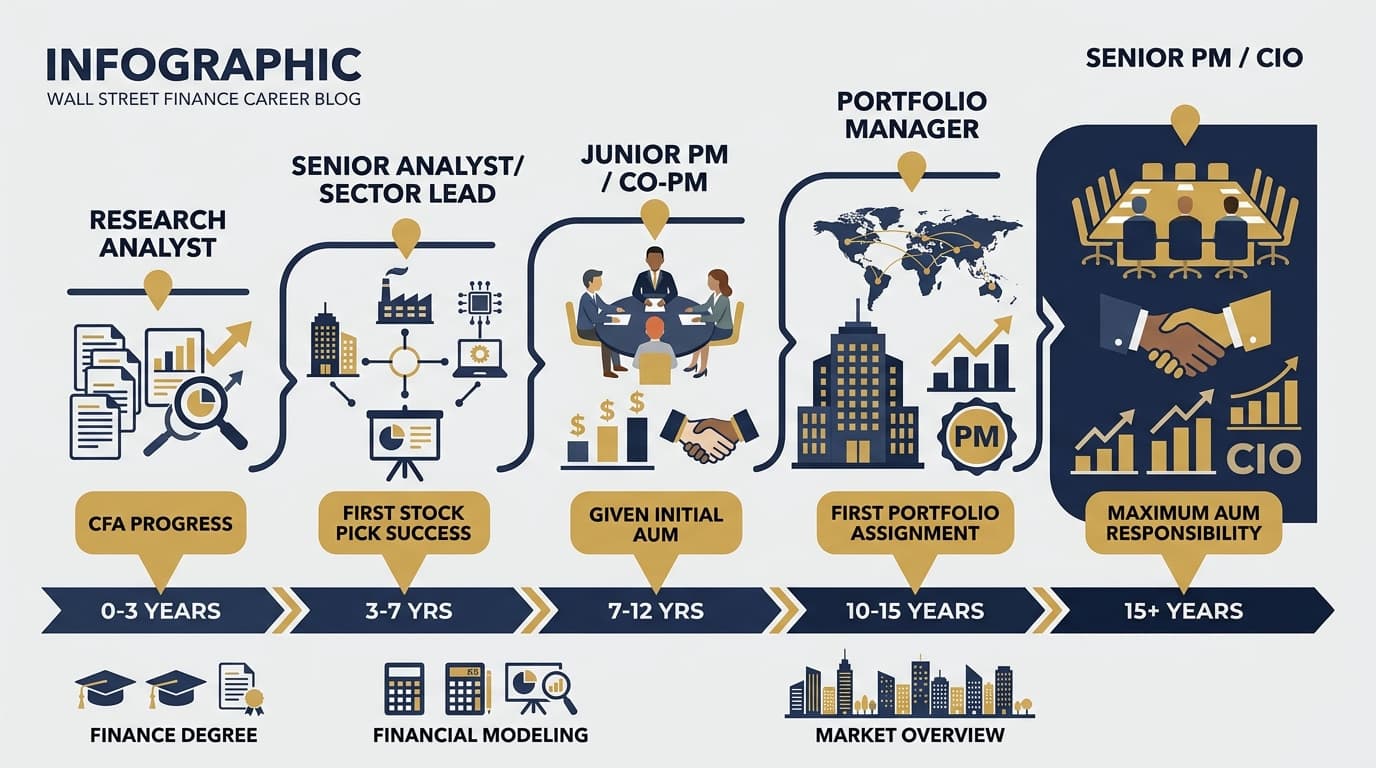
Becoming a portfolio manager is one of the most coveted outcomes in finance—and one of the least understood. The title carries autonomy, intellectual satisfaction, and significant compensation. But the path to PM is neither linear nor guaranteed, and the journey looks different depending on the asset class, firm type, and your starting point.
This guide maps the realistic trajectory from entry-level analyst to portfolio manager, including the transitions most people don't plan for until it's too late.
The Standard Career Ladder
| Stage | Title | Typical Years | Key Responsibility |
|---|---|---|---|
| 1 | Junior Analyst | 0-2 years | Financial modeling, screening, data gathering |
| 2 | Analyst | 2-5 years | Coverage of sectors/names, investment recommendations |
| 3 | Senior Analyst | 5-8 years | Lead coverage, high-conviction ideas, mentoring juniors |
| 4 | Associate PM / Deputy PM | 8-12 years | Managing a sleeve of the portfolio, co-decision making |
| 5 | Portfolio Manager | 12-20+ years | Full P&L ownership, capital allocation, risk management |
These timelines vary substantially. At a small hedge fund, you could run capital within 5-7 years. At a large traditional asset manager, the path to PM can stretch past 15 years.
Phase 1: The Analyst Years (Years 0-5)
Most future PMs start in one of three places: sell-side equity research, buy-side analyst programs, or investment banking (with a subsequent transition).
What you're building:
- Financial modeling fluency across industries
- Pattern recognition from covering dozens or hundreds of companies
- The ability to distill complex businesses into investable theses
- A track record of ideas—right and wrong—that demonstrates judgment
The analyst phase is about reps. You need volume. Cover as many companies as you can, build models from scratch, read every 10-K in your sector, and develop a point of view. PMs hire analysts who demonstrate independent thinking, not those who simply repackage consensus.
Common mistake: Spending too long on the sell side. Sell-side research teaches you how to communicate ideas and model companies, but it doesn't teach you how to manage risk, size positions, or construct portfolios. If you want to be a PM, move to the buy side within 2-4 years.
Phase 2: The Senior Analyst (Years 5-8)
This is the proving ground. As a senior analyst, your ideas directly influence portfolio construction. You're expected to generate alpha—not just analysis.
What differentiates you at this stage:
- A demonstrable track record of recommendations that made (or saved) money
- Ability to identify asymmetric risk/reward setups
- Skill in communicating conviction under uncertainty
- Understanding of portfolio-level implications (correlation, liquidity, factor exposure)
The transition from "smart analyst" to "PM-ready" happens here. Many excellent analysts never make the jump because they can't shift from bottom-up stock picking to top-down portfolio thinking.
The CFA question: A CFA charter is table stakes at most traditional asset managers and many hedge funds. It won't get you promoted to PM, but not having it can hold you back—especially at institutional firms where clients expect it. If you're targeting the PM track, start the CFA early and get it done before the senior analyst stage.
Get weekly finance recruiting intel
Technical prep tips, recruiting timeline updates, and career strategies. No spam.
No spam. Unsubscribe anytime.
Phase 3: Associate PM / Deputy PM (Years 8-12)
Not every firm has this role explicitly, but functionally it exists everywhere. You're managing a sleeve of the book—maybe $200M of a $2B fund—with increasing autonomy.
What you're doing:
- Making final buy/sell decisions on your sleeve
- Managing position sizing and risk within your mandate
- Participating in portfolio construction discussions with the lead PM
- Building relationships with allocators and institutional clients
- Mentoring junior analysts
This stage tests whether you can handle the psychological weight of P&L ownership. Generating ideas is intellectually demanding. Owning a portfolio is emotionally demanding. Markets will move against you, drawdowns will test your conviction, and you'll need to distinguish between "wrong and should cut" versus "early and should hold."
Phase 4: Portfolio Manager
Once you're running a book—whether your own fund, a dedicated strategy, or a meaningful sleeve at a multi-manager—you've arrived at the destination. But the job itself is harder than the title suggests.
The PM's actual job:
- Capital allocation across ideas, sectors, and geographies
- Risk management (drawdown limits, factor exposure, correlation)
- Team management—hiring, mentoring, and retaining analysts
- Client communication and marketing (especially for hedge funds)
- Continuous learning and adaptation as markets evolve
Compensation at the PM level:
| Firm Type | Base | Bonus / P&L Share | Total Comp Range |
|---|---|---|---|
| Large traditional AM | $300-500K | $200K-1M | $500K-1.5M |
| Hedge fund (single-manager) | $300-500K | 10-20% of P&L | $500K-10M+ |
| Multi-manager pod (Citadel, Millennium) | $300-500K | 15-25% of P&L | $1M-20M+ |
| Mutual fund PM | $250-500K | $200K-1M+ | $500K-1.5M |
The variance is enormous. A PM at a multi-manager platform who generates $50M in P&L and keeps 20% earns $10M. A PM at a traditional asset manager running a similar amount of capital might earn $800K. Structure matters as much as performance.
Recommended Resource
How to Break Into Finance - 2026
110 pages. The recruiting system from first target list to signed offer.
Common Transition Paths to PM
Not everyone follows the linear path. Here are the most common alternative routes:
Sell-side research → Buy-side analyst → PM: The classic path. Works well at long-only funds and some hedge funds.
Investment banking → Hedge fund analyst → PM: Common for event-driven, distressed, and activist funds where transaction experience is valued.
Trading → PM: Some PMs come up through trading desks, particularly in macro, rates, and systematic strategies where market microstructure knowledge matters.
Private equity / Credit → PM: Less common but growing. PMs at credit-focused funds often come from leveraged finance or direct lending backgrounds.
Entrepreneurial launch: Some analysts skip the gradual path and launch their own fund with a seed allocation. This requires a strong track record, a compelling strategy, and usually $5-10M+ of personal capital or a seeder relationship.
Looking to position your resume for portfolio management roles? Our Resume Review Service helps you highlight the exact experience hiring managers look for.
Skills That Separate PMs from Permanent Analysts
Technical skills get you to senior analyst. These skills get you to PM:
- Probabilistic thinking: Assigning odds to outcomes rather than having a single-point view
- Position sizing discipline: Knowing how much to bet matters more than what to bet on
- Emotional regulation: The ability to stay rational during drawdowns and euphoria
- Communication clarity: Explaining complex theses to non-investment audiences (clients, boards)
- Intellectual honesty: Recognizing when you're wrong and acting on it quickly
The Bottom Line
The path from analyst to portfolio manager typically takes 12-20 years, but the timeline is compressed at smaller, performance-driven firms and extended at large institutions. The CFA and raw analytical talent get you through the door—but risk management instincts, portfolio construction skills, and emotional discipline determine who actually runs capital.
If you're serious about the PM track, optimize for learning and track record in your first decade. The promotions follow the performance.
Related Reading
- PE Compensation 2026: What Associates Actually Make — How buy-side comp compares across PE
- Private Credit vs Private Equity: Key Differences in 2026 — Choosing between credit and equity career paths
- Non-Target to Investment Banking: Complete Playbook — Breaking in from a non-traditional background